
 +971 50 7774039
 +971 2 550 4002
 sales@globalalarms.ae
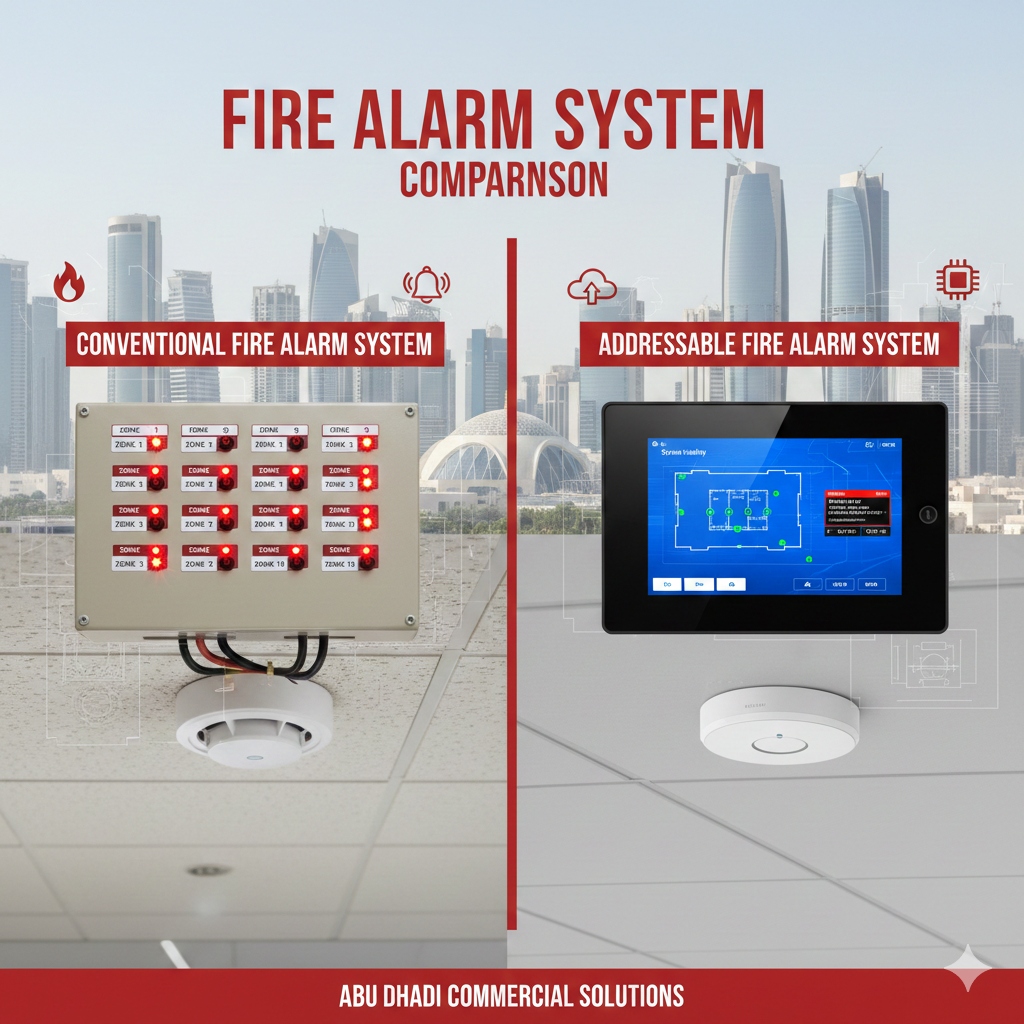
In Abu Dhabi’s rapidly advancing urban and industrial landscape, fire safety is more than regulatory compliance—it is a critical component of operational resilience and risk management. Across high-rise residential buildings, hospitality properties, oil and gas installations, and expansive commercial complexes, the choice of an appropriate fire alarm system plays a vital role in safeguarding lives, protecting valuable assets, and ensuring uninterrupted business operations.
Among the most widely implemented detection technologies are conventional fire alarm systems and addressable fire alarm systems. While both systems are designed to detect fire and alert occupants, their functionality, scalability, intelligence, and long-term value differ significantly.
This comprehensive guide provides a structured comparison to help property owners, facility managers, and project consultants in Abu Dhabi determine the most suitable solution.
Understanding Conventional Fire Alarm Systems
A conventional fire alarm system divides a building into multiple detection zones. Each zone consists of interconnected devices such as smoke detectors, heat detectors, and manual call points linked to a central control panel.
When an alarm is triggered, the panel identifies the affected zone but does not specify the exact device location. Emergency personnel must then physically inspect the zone to pinpoint the source.
I. Core Characteristics
* Devices grouped by zone
* Straightforward wiring configuration
* Lower initial capital investment
* Basic alarm identification
II. Suitable Applications
Conventional systems are generally appropriate for:
* Small offices
* Retail units
* Low-rise residential buildings
* Small warehouses
* Compact commercial facilities
For properties with limited floor area and simple layouts, conventional systems can provide reliable fire detection with cost efficiency.
Understanding Addressable Fire Alarm Systems
An addressable fire alarm system offers a more advanced and intelligent detection framework. Each device installed within the system is assigned a unique digital address, enabling the control panel to identify the exact location of an activated device.
Rather than displaying only a zone, the system provides precise information such as the specific detector number and location within the building.
I. Core Characteristics
* Individual device identification
* Intelligent communication loop architecture
* Real-time system diagnostics
* Enhanced scalability and integration capability
* Improved false alarm management
II. Suitable Applications
Addressable systems are highly recommended for:
* High-rise towers
* Hospitals and healthcare facilities
* Hotels and hospitality properties
* Large commercial complexes
* Government buildings
* Industrial plants and oil & gas facilities
* Educational institutions
In Abu Dhabi, where large-scale infrastructure and high-value developments are prominent, addressable systems are increasingly the preferred standard.
Key Factors That Influence System Selection
1. Detection Accuracy and Response Time
Addressable systems provide exact device-level information. This precision significantly reduces emergency response time and improves evacuation efficiency, particularly in multi-level or complex structures.
In contrast, conventional systems require additional on-site verification within the indicated zone, which may delay intervention in larger buildings.
2. Maintenance and Operational Efficiency
Addressable systems continuously monitor each device’s status. They can identify contamination levels, wiring faults, communication errors, and maintenance requirements before system failure occurs. This proactive capability reduces downtime and long-term maintenance costs.
Conventional systems, while dependable, do not offer device-specific diagnostics, making fault tracing more time-intensive.
3. Scalability and Future Expansion
Abu Dhabi’s development projects often expand over time. Addressable systems allow seamless integration of additional detectors and devices into the existing communication loop with minimal disruption.
Conventional systems typically require significant rewiring or panel modifications when expanding beyond original design capacity.
4. False Alarm Reduction
False alarms can disrupt operations, reduce occupant confidence, and impact regulatory standing. Addressable systems incorporate intelligent sensitivity adjustments and data analysis to distinguish between environmental factors and actual fire threats.
Conventional systems operate on simpler trigger mechanisms and are generally less adaptive in complex environments.
5. Long-Term Financial Considerations
Although conventional systems typically involve lower upfront installation costs, addressable systems often provide better long-term value in medium to large facilities.
Addressable systems contribute to:
* Faster fault detection
* Reduced operational interruptions
* Improved asset protection
* Lower lifetime maintenance costs
In high-value commercial and industrial properties across Abu Dhabi, this long-term efficiency is a decisive factor.
Compliance with Abu Dhabi Fire Safety Regulations
All fire alarm systems installed in Abu Dhabi must comply with the UAE Fire and Life Safety Code of Practice and be approved by the relevant authorities, including Abu Dhabi Civil Defence.
While both conventional and addressable systems can meet compliance requirements, larger, high-occupancy, and high-risk facilities typically require advanced detection systems capable of providing precise location data and enhanced monitoring.
Addressable fire alarm systems are often better aligned with modern regulatory expectations, especially for complex or high-rise structures.
Recommended System Based on Facility Type
I. Small and Low-Risk Buildings
For compact properties with minimal occupancy and straightforward layouts, a conventional fire alarm system may be sufficient and cost-effective.
II. Medium to Large Commercial Developments
For buildings with multiple floors, higher occupant density, or operational complexity, an addressable system offers superior control and safety intelligence.
III. Industrial and High-Risk Facilities
In environments involving heavy machinery, hazardous materials, or large open spaces, precise detection and rapid identification are critical. Addressable systems are strongly recommended in such scenarios.
Expert Fire Alarm Solutions in Abu Dhabi
At Global Alarms, we specialize in the design, supply, installation, and maintenance of fire alarm systems tailored to Abu Dhabi’s regulatory and environmental standards. Our team ensures every system is engineered for reliability, compliance, and long-term performance.
Fire protection is not merely an installation—it is a strategic safeguard for people, property, and operations.
For professional consultation on selecting the right fire alarm system for your facility in Abu Dhabi, contact Global Alarms today.
